
Researchers from the Clinical Biochemistry, Drug Delivery and Therapy Group (CB-DDT) at the Vall d’Hebron Institut of Research (VHIR), partner of the SPM4.0 consortium, have developed a fully natural, injectable soft-hydrogel that releases the chemotherapy drug docetaxel locally and gradually over two weeks. The study is the first scientific publication of the SPM4.0 project and counts among its authors SPM4.0 doctoral candidate Vincenzo Montanarella.
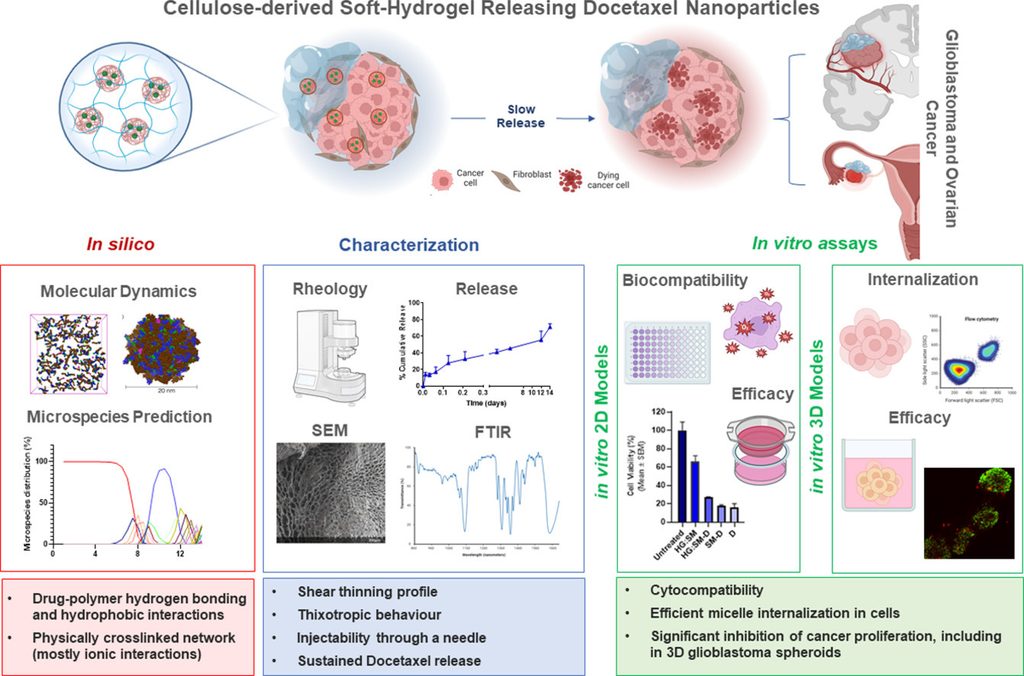
Ovarian cancer and glioblastoma are two of the most aggressive and recurrent solid tumours, and both respond poorly to systemic chemotherapy. Drugs such as docetaxel are highly potent, but their low solubility, rapid clearance from the body and dose-limiting side effects compromise their efficacy when given intravenously. At the same time, both tumours are well suited to local treatment: ovarian cancer tends to spread within the peritoneal cavity, while glioblastoma is shielded by the blood-brain barrier, which limits how much drug reaches the tumour from the bloodstream. Delivering the drug directly at the tumour site, and keeping it there for longer, is therefore an attractive alternative.
Hydrogels — soft, water-rich, tissue-like materials — are promising candidates for this kind of local therapy, but they face two recurring problems: many rely on synthetic polymers or chemical crosslinkers that may compromise biocompatibility, and their hydrophilic networks struggle to hold and slowly release highly hydrophobic drugs like docetaxel. The CB-DDT team tackled both limitations at once. Their soft-hydrogel is made exclusively from two natural polysaccharides, cellulose and chitosan, held together only by physical interactions (ionic and hydrogen bonds), with no synthetic crosslinkers. Inside this matrix, the researchers embedded polymeric micelles of about 72 nm that encapsulate more than 95% of the docetaxel, acting as tiny secondary carriers that keep the drug in place and release it progressively.
A distinctive feature of the study, published in Carbohydrate Polymer Technologies and Applications, is how the formulation was designed. Rather than relying only on trial-and-error optimisation, the team combined in silico microspecies prediction and molecular dynamics simulations with experimental characterisation, gaining a molecular-level picture of how the polymers interact with each other and with the drug carriers. These predictions were later confirmed experimentally.
The resulting material behaves as a “smart” depot: it becomes fluid when pushed through a syringe and recovers its structure once injected (a property known as thixotropy), forming a reservoir in situ. Under physiological conditions, the hydrogel kept its structural integrity for more than three weeks, degraded gradually (around 50% mass loss after 28 days) and released about 70% of the docetaxel over 14 days.
In laboratory tests, the hydrogel showed excellent compatibility with healthy fibroblasts, without inducing oxidative stress, and significant antiproliferative activity in ovarian cancer and glioblastoma cell lines. In 3D glioblastoma spheroids — miniature tumour models that better reproduce the dense architecture of real tumours — the micelles released from the hydrogel penetrated deep into the spheroid core, were internalised by more than 90% of living cells and caused progressive tumour cell death. As expected from a sustained-release system, the effect was slower than that of the free drug, a profile that could help reduce peak drug levels and associated side effects.
The authors stress that these are in vitro results, and that future in vivo studies will be essential to evaluate pharmacokinetics, biodegradation and therapeutic efficacy before any clinical translation. Still, the platform points to promising applications, such as treating residual tumour cells after surgical resection, locoregional therapy of aggressive and recurrent tumours, or as an adjuvant to systemic chemotherapy.
For SPM4.0, this first publication reflects the expertise in nanomedicine and drug delivery that the CB-DDT group brings to the network. Within the study, Vincenzo Montanarella contributed to the formulation, characterisation and preclinical validation of the drug-loaded nanoparticles for cancer treatment — an area at the core of his doctoral training at VHIR, and a clear example of the multidisciplinary, application-driven research that SPM4.0 doctoral candidates carry out across the consortium.
Congratulations to Vincenzo and the whole CB-DDT team at VHIR!
Reference article: “Naturally-derived cellulose-chitosan soft-hydrogel for sustained local docetaxel micelles delivery: from in silico modeling to preclinical validation in ovarian and glioblastoma models.” Magalí Sureda, Giacomoluciano Vitelli, Sofia Campos-Moreno, Ogechi Dike Manica Malachy, Júlia German-Cortés, Sergio José Peresson, Guillermo Goode-Romero, Fabian Ávila-Salas, Narine Fischer-Albiol, Vincenzo Montanarella, Marc Moltó Abad, Àngels Alcina-Milà, Sandra Mancilla, Belén García Prats, Zamira V. Diaz-Riascos, Antonella Accardo, Roser Ferrer Costa, Simó Schwartz Jr., Esteban Durán-Lara, Joana Marto, Rodrigo Aguayo-Ortiz, Fernanda Andrade, Diana Rafael. Carbohydrate Polymer Technologies and Applications 14 (2026) 101120. DOI: 10.1016/j.carpta.2026.101120 (open access, CC BY 4.0)