
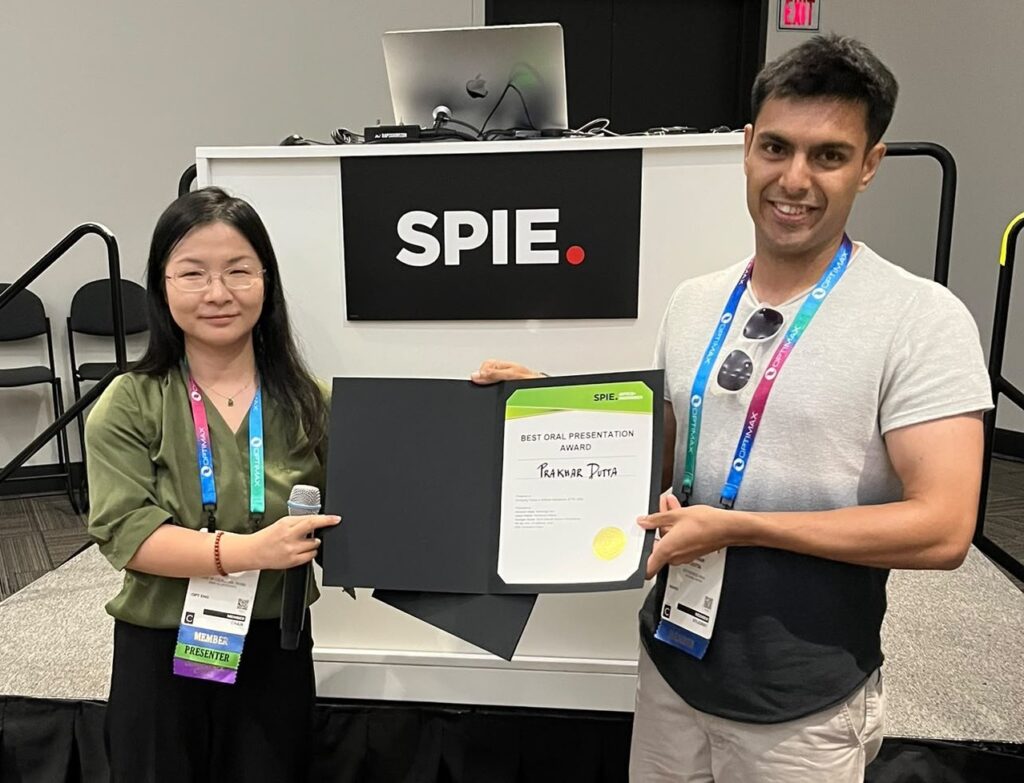
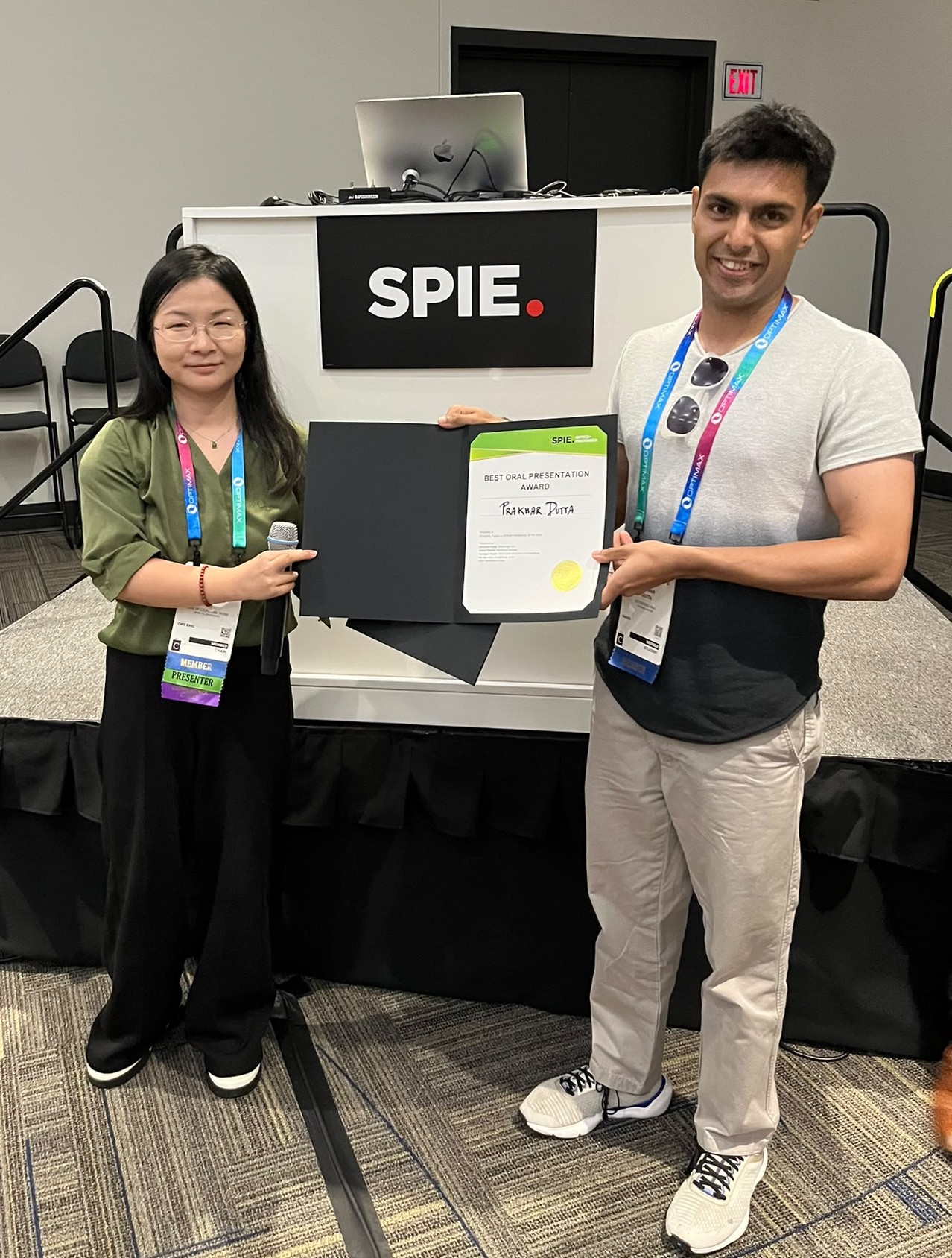
SPM4.0 doctoral candidate Prakhar Dutta, based at the University of Gothenburg (UGOT), has received the award for the best oral presentation at the SPIE-ETAI conference in San Diego, USA. The award included a certificate and a cash prize. It recognised his talk on ASAP, an open-source framework that combines physics-based simulation and deep learning to automate the analysis of atomic force microscopy (AFM) data.
The SPIE Emerging Topics in Artificial Intelligence (ETAI) conference took place as part of SPIE Optics + Photonics 2026, held from 23 to 27 August in San Diego, USA. ETAI is part of the Nanoscience + Engineering Applications programme of this major international meeting on optics and photonics. It brings together researchers working at the frontier of artificial intelligence, from new machine-learning methods to their application in imaging, microscopy and the life sciences. This makes it a natural venue for the AI-driven approaches developed within SPM4.0.
On 24 August, Prakhar presented “ASAP (AFM Simulation and Analysis Pipeline): a unified deep learning framework for simulation, quality control, and segmentation in atomic force microscopy”. His work addresses a growing challenge in the field. AFM provides nanoscale images and force–distance curves (FDCs), but the increasingly large datasets it generates make manual analysis a major bottleneck. Deep learning can automate feature extraction, quality control and segmentation. However, its use in AFM is often limited by the scarcity of ground-truth data and the technical effort needed to build robust learning pipelines.
ASAP is an open-source Python framework implemented in DeepTrack, and it tackles both limitations. Prakhar illustrated its potential through three applications:
- Mechanical property estimation: simulation of physically parameterised FDCs to train a neural network that estimates contact position and mechanical properties.
- Unsupervised quality control: an autoencoder that learns the characteristic shape of acceptable FDCs and automatically flags anomalous measurements.
- Image segmentation: simulated AFM images of DNA with exact labels, used to train a segmentation model that transfers successfully to experimental scans.
Together, these examples show how simulation, unsupervised learning and modular deep-learning workflows can reduce dependence on manual annotation. They also offer a practical route towards reproducible, AI-assisted AFM analysis.
To make his talk accessible to a broad audience, Prakhar relied on visual storytelling. “I made some animations to illustrate how atomic force microscopy actually works, and to show how the AI-enabled method we have developed is utilized,” he explained.
Prakhar joined the Department of Physics at the University of Gothenburg in October 2025 as Doctoral Candidate of the SPM4.0 network. He holds a Master’s degree in Biomedical Engineering from RWTH Aachen University. His research focuses on developing machine-learning models for the autonomous analysis of multiparametric scanning probe microscopy data.
This award highlights the quality of the research carried out by SPM4.0 doctoral candidates and the project’s commitment to bringing artificial intelligence into scanning probe microscopy. By developing open, reproducible tools such as ASAP, the consortium continues to lay the foundations for autonomous SPM in life sciences and medicine. At the same time, it is training a new generation of researchers able to communicate their science at the highest international level.
Congratulations, Prakhar!