
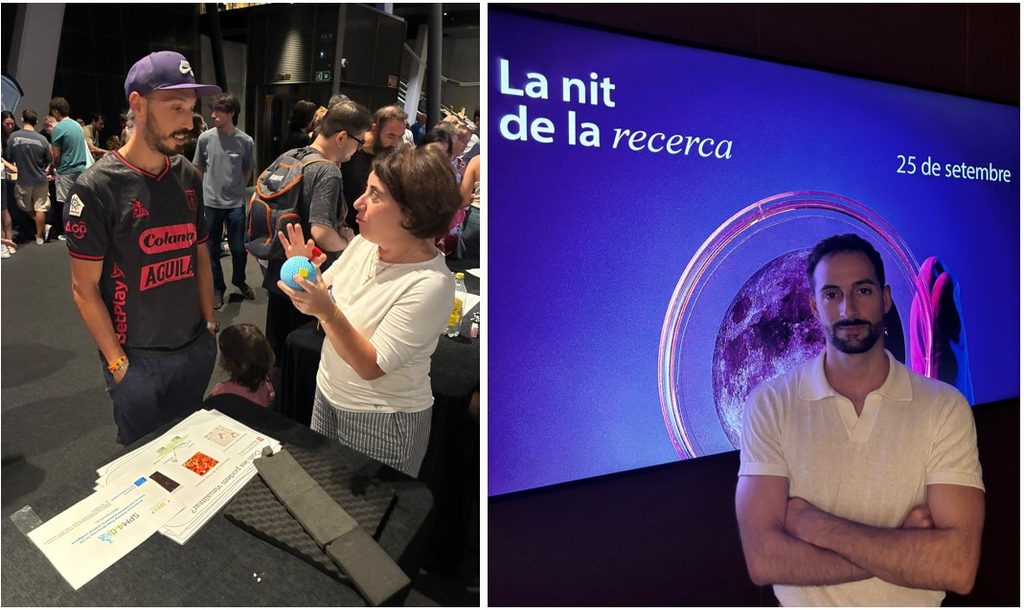
Last 25 September, SPM4.0 took part once again in the European Researchers’ Night. At the CosmoCaixa Science Museum in Barcelona, Annalisa Caló (IBEC) and Vincenzo Montanarella (VHIR) talked about atomic force microscopy, nanoparticles and nanomedicine with about 225 people of all ages.
The European Researchers’ Night is a major public event held every year on the last Friday of September, simultaneously in hundreds of cities across Europe and beyond. It has been running since 2005 and is funded by the European Commission through the Marie Skłodowska-Curie Actions (MSCA & Citizens) under Horizon Europe. On this night, universities, research centres and museums open their doors so that the public can meet researchers face to face and learn about their work through talks, workshops, games and experiments. The aim is to bring research closer to the public, to show how science affects our daily lives and to spark young people’s interest in research careers.
CosmoCaixa Science Museum in Barcelona was one of the venues for the event. From 18:00 to 22:00 visitors could join a wide range of free activities run by researchers from centres across Catalonia, and two of them featured SPM4.0 researchers.
Annalisa Caló: from molecules to materials
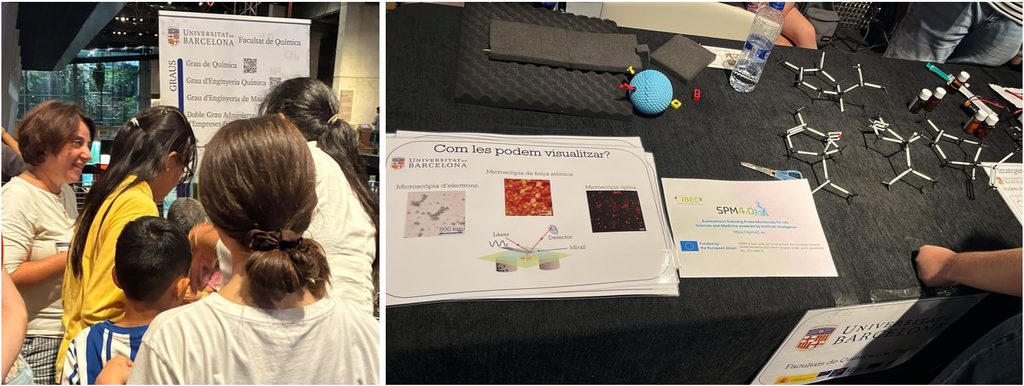
Annalisa Caló, researcher at the Nanoscale bioelectrical characterization group at IBEC, took part for the second year in a row in the stand run by the University of Barcelona at the Research Fair. The activity, entitled “From molecules to materials: chemistry to build a better future”, showed how organic chemistry can help create a healthier and more sustainable world. Using interactive demonstrations, models and simple experiments, the team showed how simple molecules can be turned into complex compounds and advanced materials to address key challenges in biomedicine, green energy and environmental sustainability. About 200 people visited the stand.
Annalisa used a 3D-printed model of a nanoparticle as a starting point. She explained that the surface of these nanoparticles is made of lipids, which can fuse with the lipids of the cell membrane so that the drug they carry can enter the cell and act. She also showed that the real nanoparticles are so small that an optical microscope cannot see them, and that a much more powerful technique is needed. This was the cue to introduce atomic force microscopy (AFM), the technique at the heart of SPM4.0.
With a foam model of an AFM tip and a foam surface, Annalisa showed how the tip touches the sample point by point to build an image of it. She explained that this approach can be used to study cells and to compare healthy and diseased cells. In cancer, for example, cells change their stiffness. AFM can also be used to study the electrical properties of cells, which is the focus of her group’s research.
Vincenzo Montanarella: a speed dating with science
Vincenzo Montanarella, SPM4.0 Doctoral Candidate at the Vall d’Hebron Institut de Recerca (VHIR), took part in the Speed Dating, an activity for teenagers and adults. Researchers sit at tables while the public moves from one to the next, spending a few minutes with each one to ask questions about their work. When the bell rings, everyone moves on to the next table. About 25 people talked with Vincenzo during the session.
Undergraduate students wanted to know about his academic path, why he chose to do a PhD, what a normal day in the lab looks like and what advice he would give for their future careers. With people from other fields, Vincenzo explained his group’s research. He focused on the benefits that nanomedicine and controlled drug delivery systems could bring to cancer patients, such as fewer side effects and shorter hospital stays. Some visitors also asked big questions, such as whether a definitive cure for cancer already exists, or whether investing millions or even billions of euros could lead to one.
“One of the things I enjoyed most was seeing people smile when I talked about treatments that could help patients cope better with therapy, also psychologically,” Vincenzo said. “Many of them told me: “Good luck with your work, it is really important. We all hope it can lead to something good in the future.” “Hearing this was very rewarding, and it reminded me how important it is to bring research closer to society and to explain how our work can have a real impact on patients’ lives”, concluded Vincenzo.
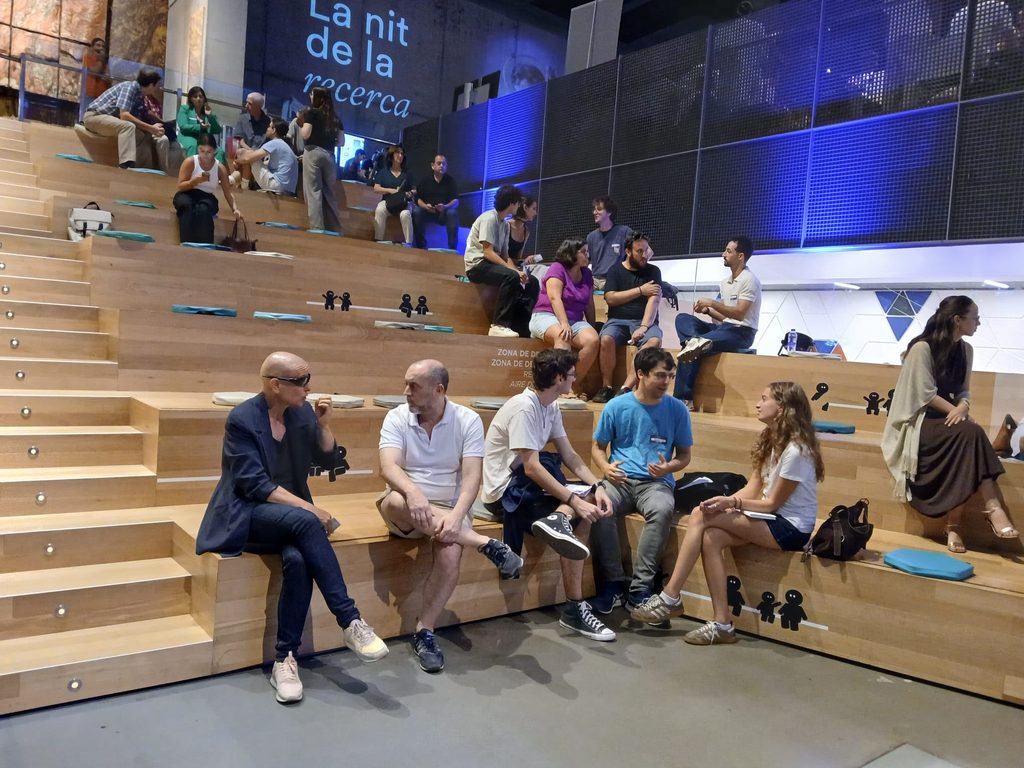
By taking part in the European Researchers’ Night, SPM4.0 reaffirms its commitment to science communication and to research that is open to society. Initiatives like this one allow researchers to share their work outside the lab, to answer the questions and curiosity of people of all ages, and to help inspire new scientific careers.